
|
2 Celestial Sphere
4. THE TABULATED AND CALCULATED COMPONENTS
All the tools necessary for Astro-navigation have already been mentioned in the above sections. These are: –
- A sextant for measuring the altitude of a celestial body
- Chronometer or watch for noting the precise instant of observation
- An N.A. that gives the celestial position of the body observed
- Inspection tables, which give the calculated altitude with which to compare with the Obs. Alt. in order to derive a position line to plot on the chart.
The various elements or figures obtained from these tools may be divided into two categories:
the tabulated components – b. the calculated components
The tabulated components are those obtainable from the N.A. and the components give the celestial position of the body observed at the time of the sextant observation – the calculated components are those figures obtained from the sextant and chronometer with which certain calculations can produce the necessary data to plot a position line. As stated above, these calculations are reduced to very simple proportions by the use of Inspection Tables.
In § 1-5 we shall explain the tabulated components, that is, how the position of a celestial body is described in the N.A. In § 6-8; a description of the measurement of time which is of supreme importance in Astro-navigation, and in § 9-13, we move on to describe a sextant and how it is used to measure altitudes and the calculated components. Further Chapters of this ‘Ocean Navigation’ will explain how all these various components can be put together to derive a position line.
5. THE CELESTIAL SPHERE
 ASTRO-NAVIGATION IS BASED ON THE CONCEPT OF AN IMMENSE CELESTIAL SPHERE HAVING THE SAME CENTRE AS, AND SURROUNDING THE EARTH SPHERE, AS SHOWN IN FIG 2-1.
Although this celestial sphere is purely imaginary and has no definite boundary, it is easiest to imagine it as a huge sphere with a surface of transparent glass, surrounding the Earth and with the interior concave surface of the glass equidistant from every point on the Earth’s surface.
The conception of nautical Astronomy the student has to develop is that an observer stationed on the Earth looks out into space and imagines the celestial bodies to be projected onto the interior concave surface of a celestial sphere that has the same centre as the Earth. At the time of observation, the bodies are supposed to be momentarily stationary and are viewed outward from the centre of the Earth so that they appear to be projected on the Earth’s surface as well as on the celestial sphere.
Once this idea of the celestial sphere is appreciated, it will be easy to understand how all the stars and other celestial bodies irrespective of their actual distances from the Earth, appear to be situated on the interior concave surface of the celestial sphere.
In fig. 2-2, the celestial and terrestrial spheres have the same common centre C, the centre of the Earth. The Celestial Poles are the points P and P1 in which the Earth’s axis if produced would cut the celestial sphere.
The Celestial Equator (also called the Equinoctial) is the great circle (WE in fig. 2-2.) in which the plane of the Earth’s equator (we) cuts the celestial sphere.
6. APPARENT MOTION ON THE CELESTIAL SPHERE
Within the celestial sphere, which is fixed, the Earth rotates about its axis, turning eastward, but an observer on the Earth is not aware of this rotation unless he watches the movements of objects in no way connected with the Earth. The celestial sphere, therefore, appears to rotate westward (as shown in fig. 2-2.) and for this reason, the Sun and the stars appear to rise E. of, and to set W. of, the observer’s meridian.
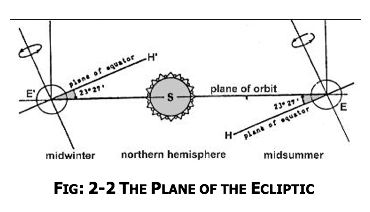
 The apparent path of the Sun in the celestial sphere is called the ecliptic. It is a great circle, and it makes an angle of 23° 27 with the celestial equator because the Earth’s axis of rotation is tilted that amount from the perpendicular to the plane of the Earth’s orbit around the Sun.
Fig 2-3., shows the tilt of the Earth’s axis in relation to the Sun when the Earth is at those positions in its orbit which give rise to midsummer and midwinter to an observer in the northern hemisphere. At the midsummer position, E, the Sun is raised above the plane of the equator by an amount equal to the tilt of the Earth’s axis, which is 23° 27’. At the midwinter position, E, the Sun is depressed an equal amount below the plane of the equator. The plane of the ecliptic is therefore inclined at an angle of 23° 27’ to the plane of the equator; this is often called the obliquity of the ecliptic.
It will be seen from fig 2-3., that the ecliptic cuts the celestial equator at two points. The one through which the Sun passes on about the 21st Mar is called the First Point of Aries (F.P. of Aries), or the vernal equinox, and is denoted by the sign ♈︎. The Ram’s horns in the signs of the Zodiac; and the other, through which the Sun passes on about 23rd Sep, is called the First Point of Libra (FPL) or the autumnal equinox and is denoted by the sign ♎️, the Scales.
The F.P. of Aries takes its name from the constellation Aries through which the Sun appears to pass when the early Astronomers decided its path.
There is, however, a slow backward movement of the actual point of the intersection of the ecliptic and celestial equator along the ecliptic, so that the F.P. of Aries no longer coincides with the position of the constellation Aries in the celestial sphere.
Meridians and parallels are “conceived to be drawn” on the celestial sphere just as they are on the Earth. The Celestial Meridians are semi-great circles joining the celestial poles, and they correspond exactly to the terrestrial meridians. Small circles on the celestial sphere parallel to the celestial equator are called Parallels of Dec. – these will be described further in § 9-13.
|