
|
16 MERIDIAN ALTITUDES & SOLAR NOON LONGITUDE
67. SOLAR NOON LONGITUDE BY EQUAL ALTITUDES
The method described above for calculating the time of Mer. Pass. is quite accurate enough for determining the time at which to observe the Mer. Alt. of a celestial body in order to obtain the Lat. It is not, however absolutely precise unless the estimated Longitude used in the calculation just happens to be the vessel’s actual Longitude at the time of Mer. Pass., a somewhat rare occurrence. If, however, the precise time of Mer. Pass. can be determined, this would provide a very simple method of finding the Longitude at this time because the Longitude must then be equal to the G.H.A. of the body, since G.H.A. ~ L.H.A. = Longitude and the L.H.A. at Mer. Pass. is 000° 00.0 (or 360° 00.0)
The rate of change of altitude of the Sun when near the meridian is too Slow to permit the time of Mer. Pass. to be determined with sufficient accuracy by merely observing when the altitude is at a maximum. If, however, an altitude is taken at a reasonable interval before Mer. Pass., at a time when the Sun is rising at a reasonable rate, and the time noted to the nearest second, and then, at the same interval after Mer. Pass., the time at which the same altitude is again obtained is carefully and precisely noted, then, provided the vessel has not changed her Lat. between the sights, the mean of the times (G.M.T.) of the two sights will be the precise G.M.T. of Mer. Pass., and the vessel’s Longitude will be the G.H.A. of the Sun at this time.
In taking equal altitude observations for the purpose of determining solar noon Longitude the interval before and after Mer. Pass., should be at least as many minutes as there are degrees in the Lat., e.g., in Lat. 5O° N., the forenoon sight should be taken not later than 50 min. before Mer. Pass. If there seems a risk that cloud nay prevent the afternoon observation being obtained, it is advisable to precede the intended forenoon sight by a series of earlier ones, e.g., three or four at intervals of 10 min. or so, noting the Sextant reading and time (to the nearest second) in each case. If this is done it will be hard luck indeed if cloud does not permit an afternoon observation which pairs with one of the forenoon ones and occurs at a time which is as long after Mer. Pass. as the particular forenoon observations is before it.
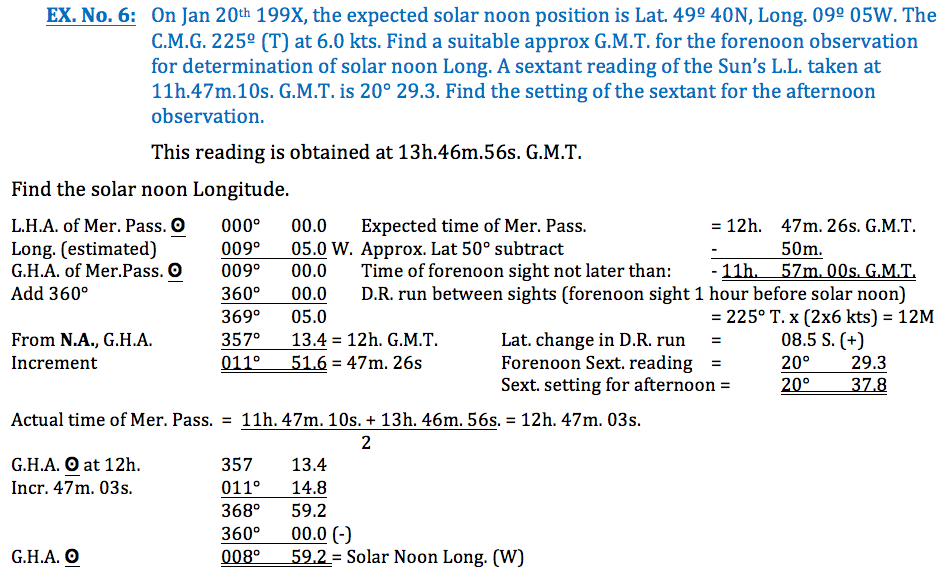
If the vessel changes her Lat. in the interval between forenoon and afternoon sights, the angle to set on the sextant should be changed (relative to the reading obtained in the forenoon), by the number of minutes of change of Lat. being increased if the Lat. change is toward the Sun, or decreased if the Lat. change is away from the Sun. Change of Lat. in the interval between the two observations can be obtained by D.R. from the (T) course and D.M.G. either graphically, by chart plotting, or by use of the traverse table.
If there is no (or only negligible) change of Lat. between the two sights, i.e., if the two altitudes forenoon and afternoon, are the same (or nearly so) for both observations, there is never any need to apply corrections to the Sextant readings since they will be the same in both cases.
In a small craft it is unlikely to be necessary to apply sextant corrections even if there is a Lat. change, because the amount of this change will hardly ever be enough to produce a material change in the corrections. If, however, the vessel is proceeding sufficiently fast and on such a course that the Lat. change between forenoon and afternoon sights is enough to make the Sun’s altitude correction different for the two observations, the change in the correction should be included when setting the sextant for the afternoon observation.
The practical working of solar noon Longitude by equal altitudes is simplicity itself. First calculate the time of Mer. Pass. as described earlier in this Chapter, then subtract from this time at least as many minutes as there are degrees in the Lat. to obtain the time for the forenoon sight. Take this sight, noting the Sextant reading and the time (to the nearest second) when it was obtained.
The difference between this time and the calculated time of Mer. Pass. should now be added to the calculated time of Mer. Pass. to give the approximate time of the afternoon sight. Next, from the (T) course and distance estimated to be made good between the forenoon and afternoon sights, find the estimated change of Lat., if any). When the approximate time for the afternoon sight is approaching, set the sextant to the forenoon reading, increased or decreased by the estimated change of Lat. (if any), and note the time (again to the nearest second) when this reading is obtained. Finally, add the two noted times together and divide by two to find the true time of the Sun’s Mer. Pass.) and with this time extract from the N.A. the Sun’s G.H.A. which will be the vessel’s Longitude at solar noon. This Longitude and a Mer. Alt. observation for Lat. taken mid-way between the forenoon and afternoon sights, provide a delightfully simple way of fixing a vessel’s position at solar noon (time of Mer. Pass.), requiring, nothing but the N.A. for working out.
|