
|
30 LATITUDE BY OBSERVATION OF POLARIS (THE POLE STAR)
116. THE VALUE OF *POLARIS.
In § 4 of this study, it was shown that the altitude of the celestial pole is equal to the Lat. of the observer. If a star had a Dec. of 90° it would be situated at the celestial pole and its altitude would, therefore, be equal to the altitude of the celestial pole and the Lat. of the observer. Unfortunately no such exists, but as was shown in § 7, there is a relatively bright star Ursa Minoris, *Polaris or the Pole Star (magnitude 2.2). which is very near to the celestial pole.
The Dec. of Polaris is a little more than 89°. It lies, therefore, within a degree of the N. celestial pole and it follows that the altitude or Polaris is never different from the Lat. of the observer by more than a degree or less. When Polaris is on the observer’s upper celestial meridian its altitude is about one degree greater than the Lat. of the observer, and when it is at lower Mer. Pass. its altitude about one degree less than the Lat. of the observer. When its L.H.A. is about 90° or 270° its altitude is roughly equal to the Lat. of the observer. A correction apply to the altitude of Polaris in order to find the Lat. of the observer is provided in the N.A.
Finding Lat. from an observation of Polaris (the seaman’s star) is probably the earliest Astronomical method for finding Lat. at sea. Most people can locate the Pole Star in the night sky and directions for doing so were given in § 7. When in the northern hemisphere between about 10° and 68° N., a sight of Polaris taken at morning or evening twilight can provide the vessel’s Lat. with the minimum of calculation and no plotting. If this is crossed with a suitably angled position line from another celestial body or bodies, an immediate position can thus be obtained. Since Polaris is not a very bright star it can frequently be lost to the naked eye in the gathering light of morning twilight before the horizon is sufficiently clear for observations, and at evening twilight it is not often visible to the naked eye before the gathering dusk has similarly rendered the horizon useless. However, *Polaris can usually be picked up in the sextant telescope when it is not visible to the naked eye setting the sextant to the D.R. Lat. and sweeping the horizon in a due Northerly direction. A more precise method will be explained later.
The limits of Lat. for observations of *Polaris were defined above as 10° N. and 68° N. In latitudes lower than 10° the Pole Star is too near the horizon for it to be suitable for navigational purposes, while the Pole Star Tables in the N.A. extend only to 68° N., which Lat. approximates to the northern limit of surface navigation.
The correction to apply to the altitude of *Polaris in order to find the Lat. of observer can be found in the *Polaris (Pole Star) Tables for the year, at the end of the N.A. before the increment tables (PAGE 10 IN THE AN PAMPHLET). The correction is a function of the L.H.A. of Polaris and the Lat. of the observer. The Pole Star Tables give these corrections against the arguments L.H.A. Aries., Lat. of the observer, and month of the year. The three corrections are denoted by ao, a1, and a2. They are to be added together and their sum diminished by 1°. The Lat. of the observer is then found by applying the resultant correction to the True. Alt. of the star thus: –
 Lat. = True. Alt. Polaris -1° + ao , + a1 , + a2 .
In addition to the altitude correction for determining Lat., the N.A. also provides an Azimuth Table for Polaris.
Although the Dec. of Polaris is about 89° and its S.H.A. is about 332½°, these values vary considerably in comparison with the variation of declination and S.H.A.’s of the stars, because of the precession of the Earth’s axis. Because the Earth is a spinning body it possesses the property known as gyroscopic inertia. This is the expression of the tendency a spinning body has to maintain its plane of spin. Every spinning body maintains its plane of spin so long as it is not influenced by an external couple acting upon it, but an external couple causes the axis of spin of the body to trace out a conical movement the period of which is usually very long compared with that of the rotation of the body.
This motion is called precession. The revolution of the Earth around the Sun, the Earth’s oblate shape, and the fact that the plane of the Earth’s spin is inclined to that of her orbit around the Sun, results in Earth’s axis precessing, the period of precession being about 26,000 years.
Since the Dec. of *Polaris is about 89°, its polar distance is thus approximately 1°, and in the course of a day, the Pole Star describes a small circle about the Pole with an angular radius of about 1°, this radius being represented by P in fig 30-1.
Fig. 30-2 is the familiar figure representing the observer’s celestial horizon on the equidistant projection, but the circumpolar parallel of Dec. of *Polaris has been exaggerated because it is not possible to draw the 1° radius on such a small scale with sufficient clarity for explanatory purposes. This part of the figure has been further enlarged in fig. 30-3. In these figures:
 P is the N. celestial pole
Z is the observer’s zenith
N is the N. point of the celestial horizon is the F.P. of Aries
X is Polaris
Angle YPX is the L.H.A. of *Polaris (about 30° in this example)
When *Polaris is at some position X, its True. Alt. is AX, and since XY is the parallel of altitude of X, then AX = NY. The following deduction can therefore be made: –
Lat. of observer = altitude of pole
= arc NP
= NY ± PY (minus in this figure)
= True. Alt. of Polaris ± PY
(N.B. when the L.H.A. of *Polaris is between 90° and 270° the correction PYT has to be added to the True. Alt. of *Polaris to find the Lat..)
The problem is therefore to find the correction PY for any hour angle, because the length of PY clearly depends on the position of X, and the position of X depends on the hour angle. The argument used in the Pole Star Tables is not the L.H.A. of *Polaris but the L.H.A. of Aries. This is used as an argument because it avoids the necessity of finding the S.H.A. of *Polaris, the value of which changes comparatively rapidly because of the precession of the celestial poles.
Since the angular radius of the parallel of Dec. of *Polaris about P is small, the arc AY approximates closely to the perpendicular XY1 in fig. 30-2 and the right-angled triangle PXY1 is sufficiently small to be considered plane. The main correction ao in the Pole Star Tables is based on this assumption but because of this, an additional correction a1 must be applied to allow for the spherical shape of the triangle. When the L.H.A. of *Polaris is 0° (i.e., when the L.H.A. of Aries is 27° 33.0) the correction is numerically equal to the polar distance of *Polaris and should be subtracted from the altitude of *Polaris. When the L.H.A. of Polaris is 180° (i.e., when the L.H.A. of Aries is 207° 33.0) the correction should be added to the altitude of *Polaris. In order to keep the ao correction always positive, it is adjusted by adding a constant 58.8 to it. Similarly, the a1 correction has a constant 0.6 added to it. The third correction a2 gives corrections which allow for the changing Dec. and S.H.A. of *Polaris throughout the year. The corrections are calculated using a mean position for Polaris and adjusted by adding a constant 0.6 so that the correction a2 is always positive.
It will be noticed that the sum of the added constants is 1°, so before applying the three positive corrections, the True. Alt. of Polaris must be reduced by 1° thus: –
Lat. of observer = True alt. of *Polaris – 1° + ao + a1 + a2
117. PROCEDURE FOR FINDING THE LATITUDE BY *POLARIS
Add 1° to D.R. Lat and subtract ao. (from Pole Star Tables in the NA, using the approximate L.H.A. of Aries for the Deck Watch Time). Set this approximate altitude on the sextant and locate Polaris on the N. horizon.
Correct the observed Sext. Alt. of Polaris in the same way as the altitude of any other star is corrected, for I.E., dip and star’s total correction. Subtract 1° from the True. Alt..
From the DWT of the observation calculate the L.H.A. of Aries. Great accuracy is not required here since the maximum change of ao per degree is only 1.0. It is therefore sufficient to work to the nearest minute of time.
With this L.H.A. of Aries, take out ao from the Pole Star Tables, interpolating as necessary.
Enter the second table in the same column with the D.R. Lat. (to the nearest tabulated value) and take out a1.
Enter the third table in the same column with the month and take out a2.
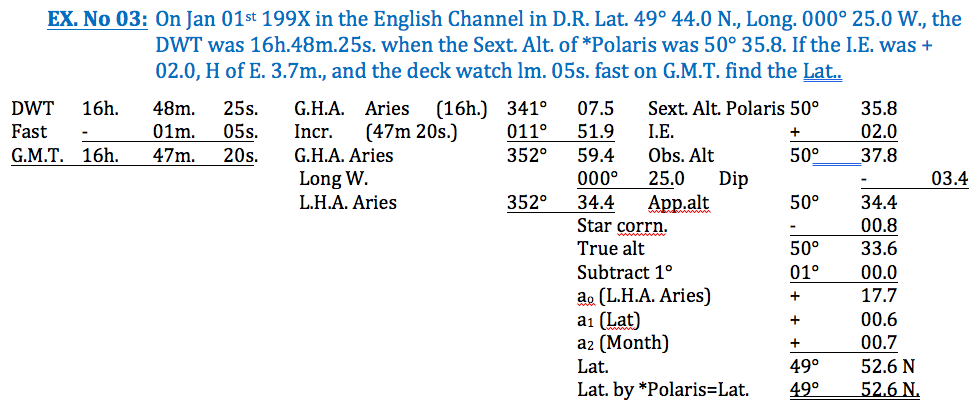
Add ao. + al + a2. to (True. Alt. – 1°). The result is the observer’s Lat.
Because the azimuth of *Polaris does not exceed 2°, the position line may be taken as lying along a parallel of Lat. and drawn 090° ~ 270° on a plotting chart, similar to a meridian altitude P/L.
|