
|
28 PLANNING STELLAR AND PLANETARY OBSERVATIONS
106. THE RISING AND SETTING OF CELESTIAL BODIES.
The ability to measure the altitude of a celestial body with a sextant is dependent on two factors; –
(i) that the body itself is visible in the sky and (ii) that the observer’s horizon is clearly defined
In the case of stellar and planet observations, in general, these two conditions are only met during morning and evening twilight although certain of the navigational planets are occasionally observable during daylight hours.
During the hours of darkness, the stars may be fully visible but the horizon is too vaguely defined (even in the moonlight) for accurate observations, while during the day the horizon may be clearly defined but no stars are visible.
Knowledge of the rising and setting of celestial bodies is essential to the navigator because the times at which he can take his star sights are governed to a large extent by the times of sunrise and sunset. Theoretical rising or setting occurs when the centre of the celestial body is on the observer’s celestial horizon, E. or W. of his meridian, when the true zenith distance is 90º but these times are not usually required in the practice of navigation. Visible rising or setting occurs when the upper limb of the celestial body is just appearing above or disappearing below the observer’s visible horizon. Visible sunrise or sunset occurs when the Sun’s upper limb appears on the visible horizon and the Obs. Alt. of the Sun’s upper limb is 0°00′.0
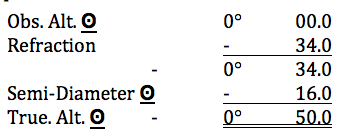
By correcting the zero altitudes, the True. Alt. and therefore the true zenith distance of the Sun’s centre can be found. Thus, if the observer is assumed to have no H. of. E. and the Sun’s semi-diameter on the day in question is 16’.0, then:
The true zenith distance would therefore be 90 50.0 and the Sun’s centre is approximately 1 below the celestial horizon when its-upper limb is just visible. For this reason visible sunrise occurs before theoretical sunrise and visible sunset after theoretical sunset.
‘The N.A. gives, on the right-hand daily pages, the times of sunrise and sunset for a range of latitudes from 60º S. to 72º N. These times, which are given to the nearest minute, are strictly the G.M.T. of the phenomena on the Greenwich meridian for the middle day of the three on each page, but are approximately the L.M.T. of the corresponding phenomena on any other meridian and may be used for any of the three days on the page. Interpolation for Lat. can be done mentally or with the aid of Table 1 of the study pamphlet).
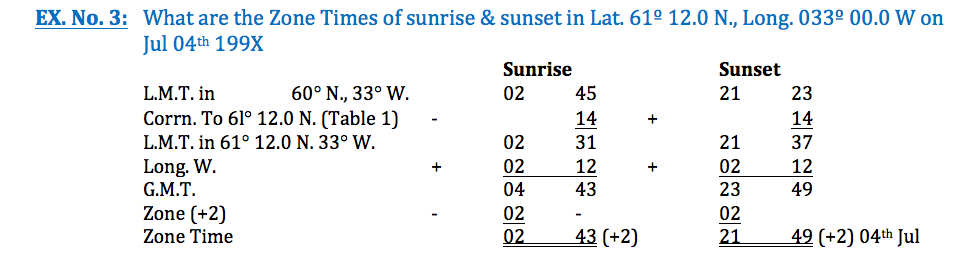
(Note that when using Table 1 to interpolate for Lat., it is essential to take out the tabular data (on the daily page) for the Lat. less than the true Lat., because the interpolation is not linear. Thus, in the above example, the L.M.T. of sunrise/sunset was extracted for Lat. 60º N. and not Lat. 62º N.)
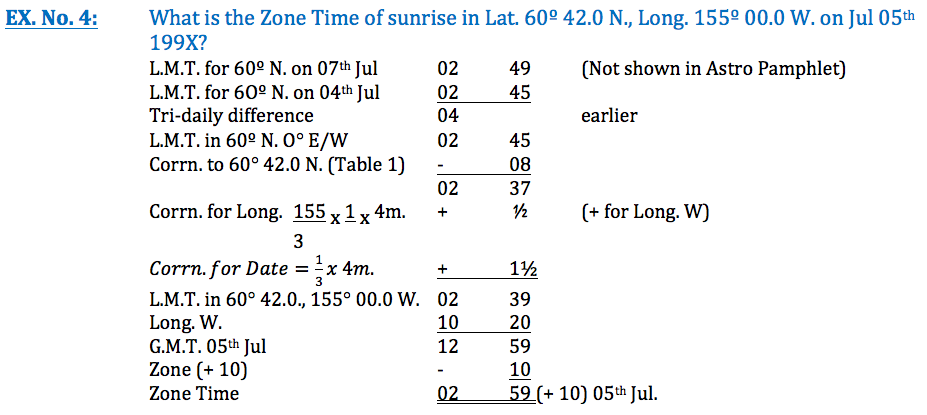
To find the precise times of sunrise or sunset. interpolation is necessary. A small correction depending on the Longitude (expressed as a fraction of a day) is added/subtracted for W/E Longitudes respectively. If the day is other than the middle day of the daily page, one third of the tri-daily difference must be added or subtracted if appropriate.
107. TWILIGHT
Twilight is that period of the day when, although the Sun is below the horizon, the observer is still receiving light reflected and scattered by the upper atmosphere. Because of the phenomenon known as atmospheric refraction (see § 9-13) and because sunlight may be reflected from particles high in the atmosphere, sunlight may be received an observer when the Sun is as much as 18º below his horizon.
Twilight is divided into three stages. Civil twilight is the period between sunrise or sunset and the time when the Sun’s centre is 6º below the horizon, during which time the natural light is sufficiently strong to obviate the necessity for artificial lighting.
Nautical Twilight is the period when the Sun’s centre is between 6º and 12º below the horizon and the natural light is sufficiently strong for the seaman to see his visible horizon but sufficiently weak for most of the brighter stars to be visible. Astronomical twilight is the period when the Sun’s centre is between 12º and 18º below the horizon and the natural light is relatively weak. At 18º below the horizon absolute darkness (as far as the sun is concerned) is assumed to begin or end. Tables giving the times of commencement of civil and-nautical twilight are given on the daily pages of the N.A., and are used in exactly the same way as those for sunrise and sunset.
The difference between the times for civil twilight and nautical twilight therefore gives the navigator the duration of nautical twilight but it should be understood that at the times given for nautical twilight the horizon is in general not visible, it being too dark for observation, while at the times given for civil twilight (in good conditions and in the absence of other illumination) the horizon is clearly defined and the brightest stars are still visible. In these tables, the following symbols are used to indicate the conditions under which, in high latitudes, some of the phenomena do not occur: –
ΓΓΓ Sun or Moon remains continuously above the horizon. ΟΟΟ Sun or Moon remains continuously below the horizon.
///// Twilight lasts all night.
The duration of twilight is related to the angle, which the plane of the Sun’s diurnal circle makes with the plane of the horizon. The bigger is this angle the shorter will be the duration of twilight. At the equator the Sun sinks into and rises out of the horizon perpendicularly, so that the duration of twilight is relatively short. In high latitudes, the Sun’s apparent diurnal path at rising or setting makes a relatively small angle (an angle which decreases as the Lat. increases) with the horizon so that the duration of twilight is relatively Longitude Figures 28-1 (a) and (b) serve to illustrate that twilight is of shorter duration in the tropics than in higher latitudes.
In fig. 28-1 (a) WX represents the path of the Sun when its Dec. is 0º; at a place in Lat. arc NP. The angle XPW is a measure of the time during which the Sun is in the twilight zone. In fig. 28-1 (b). the time during which the Sun is in the twilight zone is angle XPW, and clearly, this angle is greater than the corresponding angle in fig. 28-1 (a) because Lat. is greater and therefore the Sun passes through the twilight belt more obliquely than is the case in a lower Lat.
If the Sun does not sink lower than about 18 below the horizon, twilight will last all night. Fig. 26-2 serves to illustrate that for twilight to last all night the Lat. of the observer and the Sun’s Dec. must have the same name and their sum must not be less than 72 Fig. 26-2 represents the celestial sphere projected onto the plane of the horizon of an observer whose zenith is at Z., and N,E,S and W are the cardinal points of the horizon. The outer circle represents the parallel altitude of 18 below the horizon.
 For twilight to last all night, the Sun’s diurnal circle must not cross this parallel of altitude. In fig. 26-2, the circle centred at P just grazes the parallel of altitude of 18º below the horizon at X. This is the diurnal circle of a celestial body, which crosses the observer’s celestial meridian when at upper transit at Y. It Dec. therefore, is equal to arc QY and…
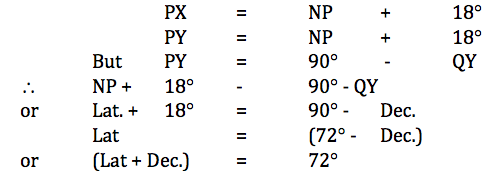
Thus, for twilight to last all night, the sum of the observer’s Lat. and the Sun’s Dec. must equal or be not less than 72º. In other words, if the observer’s Lat. is not less than (72º – Sun’s Dec.) twilight will last all night. Therefore, the lowest Lat. at which twilight can last all night is (72º – 23½) that is, Lat. 48½(because 23½ is the Sun’s maximum Dec.).
The phenomenon known as the “Midnight Sun” can be similarly explained. If the circle of the Sun’s Dec. does not reach the horizon, then the Sun can never set. In the northern hemisphere, the limiting Lat. for this to occur can be seen in fig. 28-3 to be (90- 23½) = 66½N., although in this Lat. the Sun will remain above the horizon all night on one occasion only during the year.
The limits referred to above for either twilight or sunlight to last all night, with their names altered to S.. also apply in the Southern hemisphere.
108. THE PLANNING OF STELLAR AND PLANETARY OBSERVATIONS.
The short period of nautical twilight (particularly in lower latitudes) and the desirability of making several observations as near simultaneously as possible in order to obtain an Astronomical fix without the complication of plotting runs between sights, makes the planning of stellar observations beforehand a highly desirable navigational practice.
 Stars can be observed with a marine sextant when the Sun’s centre is depressed more than 3 below the visible horizon. The horizon, however, becomes too indistinct for observation when the Sun’s centre is depressed more than 9 below the horizon. In general, the altitudes of stars may therefore be measured when the sun’s depression is between 3 and 9, and the middle of this observing period is the time quoted in the N.A. for Civil twilight. Plans for taking star sights should be based on this time.
Whichever method the navigator uses to identify stars, the first step consists of calculating the L.H.A. of Aries for the time of Civil twilight extracted for the date from the N.A. A star globe or planisphere should then be set up for the L.H.A. of Aries and the observer’s Lat. as described earlier in this Chapter, when the bearings and altitudes of the navigational stars most suitable for observation can be selected and noted down. With the Nautical Star Chart, the observer’s position at the time of Civil twilight would be plotted (using the L.H.A. Aries as a substitute for Longitude) and again the approximate bearings and altitudes of the most suitable stars for observation can be noted. Reference should also be made to the Planet Diagram and Notes in the N.A. to determine what planets will be available and choose three or more stars and planets to give the best cuts of position lines. Two should be about 90º apart. The best combination is, if possible, four stars 90º apart in azimuth, because any abnormal refraction error will be eliminated by using opposite horizons. Stars should be selected with altitudes between 30º and 60º for preference and, where possible, with approximately the same altitude. At least four additional stars should also be selected as standbys, in case the sky is partly cloudy and the first choice of stars is obscured. Make a list of the approximate altitudes and bearings of the chosen stars together with a rough sketch showing the bearings relative to the course of the vessel in order to make identification easier (see the examples on Brown’s Nautical Star Chart)
Observe stars as early as possible at evening twilight and as late as possible at morning twilight because the horizon will then be clearest. Bear in mind that a torch will be necessary to read the sextant before the beginning of morning civil twilight and after the end of evening civil twilight unless the sextant has a built-in light.
At evening twilight it is a good plan to set on the sextant the altitude of the brightest star or planet chosen; then, knowing the approximate bearing relative to the vessel’s head, look through the sextant telescope and sweep the horizon at this point. The star will frequently be found before it is visible to the naked eye, while the horizon is still excellent. Familiarity with this method is invaluable if there is broken cloud, for then a star may be visible for only a few minutes. It is possible to take-a series of sights in this way without ever seeing the stars with the naked eye.
|